

 +1-866-732-0305
 info@doctorsolve.com

If you or someone in your family takes Eliquis, you already know how expensive it can be to fill that prescription in the United States. Eliquis is one of the most commonly used blood thinners in the U.S., but the pharmacy price can be especially difficult to manage if you are paying out of pocket.
So it’s natural to ask: is there a generic Eliquis yet, and if not, when will one actually show up on a U.S. pharmacy shelf?
The short answer is that a generic version of Eliquis (called apixaban) already exists and has been approved by the FDA. However, due to patent and legal protections, it is not widely available in U.S. pharmacies yet. Current court decisions mean most generic versions cannot be sold in the U.S. until around April 1, 2028, unless the legal situation changes.
To understand why prices remain high, it helps to start with what Eliquis is, why so many Americans rely on it, and why the generic version has taken so long to reach U.S. pharmacy shelves. From there, we’ll look at practical ways you may be able to lower your costs while waiting for more affordable options at home.
Understanding Eliquis Before Looking at Generic Options
Eliquis is the brand name for a prescription blood thinner called apixaban (7). Eliquis was first approved in 2012 to help prevent strokes and blood clots. Medical authorities like the National Institutes of Health (NIH) explain that Eliquis belongs to a class of medications known as direct oral anticoagulants (DOACs).
A key advantage of Eliquis over older, traditional blood thinners like warfarin is that it does not require regular, mandatory blood tests to monitor your levels. Because it provides effective protection without requiring regular blood tests, Eliquis offers a more convenient treatment option than warfarin for many patients.
How Eliquis Works in the Body
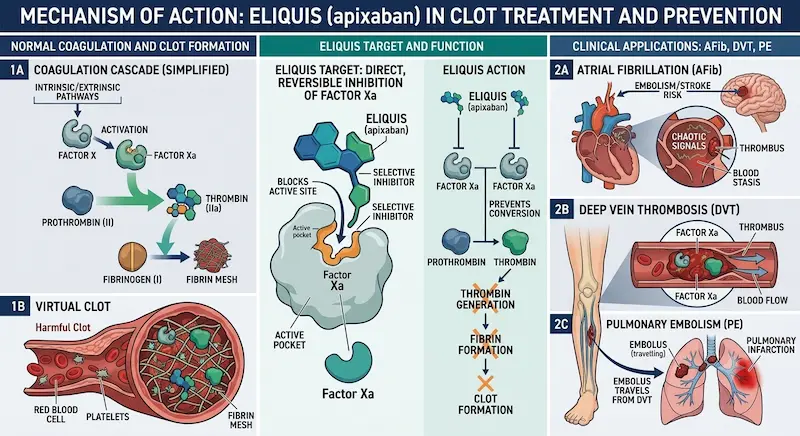
How Eliquis works in the body: By selectively targeting and blocking Factor Xa, Eliquis halts the coagulation cascade to prevent harmful blood clots in patients diagnosed with AFib, DVT, or PE.
Once you know that Eliquis is a type of blood thinner, the next question is how it helps lower the risk. Eliquis works by blocking Factor Xa, a key clotting protein in the blood that helps form blood clots. By targeting this part of the clotting process, Eliquis helps reduce the formation of dangerous blood clots. However, it does not stop clotting completely. Instead, it slows one specific step in the clotting process while still allowing your body to respond to everyday cuts and minor injuries.
Why So Many Patients Are Prescribed Eliquis
Because Eliquis affects the clotting process, doctors prescribe it for several conditions where dangerous clots can form or return. The U.S. food and drug regulator has officially approved Eliquis for several medical uses, including preventing and treating dangerous blood clots and reducing the risk of stroke in certain patients:
- Lowering Stroke Risk in AFib: Eliquis reduces the risk of stroke and blood clots in people with nonvalvular atrial fibrillation (AFib) (19). The Centers for Disease Control and Prevention (CDC) explains that AFib is an irregular heart rhythm in which blood does not flow through the heart as efficiently as it should, increasing the risk of stroke.
- Treating Deep Vein Thrombosis (DVT): Eliquis is approved to treat deep vein thrombosis (DVT) and help prevent recurrent venous thromboembolism (VTE).
- Treating Pulmonary Embolism (PE): It treats pulmonary embolism, a potentially life-threatening condition that usually occurs when a blood clot, often from a deep vein thrombosis (DVT) in the leg, travels to and blocks an artery in the lungs.
- Long-Term Protection: If you have already been treated for a blood clot in your leg (DVT) or lung (PE), Eliquis helps lower the chance of that blood clot coming back in the future.
- Surgery Recovery: It helps prevent blood clots in patients who have recently had hip or knee replacement surgery. According to the National Institutes of Health (NIH) supported research, atrial fibrillation affects an estimated 10.55 million American adults, making it one of the most common heart rhythm disorders in the United States.
Because the U.S. population is aging, research estimates that as many as 12.1 million people in the United States could have atrial fibrillation (AFib) by 2050. This means more people may need blood-thinning medications, such as Eliquis, in the future.
Available Strengths and Dosages
Once Eliquis is prescribed, the dose depends on the condition being treated and the patient’s health profile. The U.S. federal agency states that Eliquis is taken twice daily and is available in 2.5 mg and 5 mg tablets. Doctors adjust doses based on a patient’s age, weight, and kidney health, especially in older adults.
Why Patients Are Looking for a Generic Version
For many Americans, the medical need for Eliquis is clear, but the cost is the difficult part. That is why so many patients ask whether a generic version is available. The generic version of Eliquis is called apixaban. It contains the same active ingredient, works the same way, and is used to help prevent and treat blood clots. Although the FDA has approved multiple generic apixaban products, broad market availability in the United States has been delayed by patent litigation and commercial agreements. As of mid-2026, a widely available, low-cost U.S. generic remains limited, meaning many American patients continue to receive brand-name Eliquis. If you are looking for a more affordable option now, some U.S. patients compare prices through licensed Canadian pharmacy services, where generic apixaban may be available before it is broadly stocked in American pharmacies.
What Generic Eliquis Is Called
The name can be confusing because patients often search for “generic Eliquis,” while doctors and pharmacies usually use the drug name. The generic name of Eliquis is Apixaban. Apixaban is the active ingredient in Eliquis, and it is the official name used for its generic versions. Studies confirm that the generic apixaban contains the same active drug (apixaban) as Eliquis and behaves the same way in the body under tested conditions.
FDA Approval Does Not Always Mean Immediate U.S. Availability
The next point to understand is that approval and availability are not the same thing. Generic Apixaban was approved as the first generic version of apixaban on December 23, 2019. (31). Because federal guidelines require approval and strict bioequivalence testing and quality standards, approved generic drugs are considered therapeutically equivalent to the brand-name product and are expected to provide the same clinical effect and safety profile when used as directed.
When Generic Eliquis May Become Available in the U.S.
Because approval alone has not made generic Eliquis widely available, the next issue is timing. According to U.S. Guidance on Orange Book Patent Listings for Bristol-Myers Squibb and Pfizer Inc., key patent protection for Eliquis is set to expire on November 21, 2026. This is the earliest date when broader generic competition could enter the market. Even after certain patents expire, additional U.S. regulatory protections may continue to delay lower-cost generic competition. These protections can affect when American pharmacies are able to stock cheaper generic versions, which is why patients may not see broad U.S. availability right away.
Why Patents and Settlements Affect the Timeline
To see why the timeline is complicated, it helps to look at the patent protections around the drug. Eliquis is protected by multiple patents listed in the federal regulator Orange Book, covering different aspects of the drug such as formulation and methods of use. Research shows that many drugs are protected by overlapping “patent thickets,” where multiple patents are filed before and after the federal health agency approval. These overlapping protections can delay generic competition, even after U.S. guidance approval of a generic version, because manufacturers may need to wait for key patents to expire or resolve legal challenges before the product can enter the market.
How Generic Manufacturers Enter the Market
Before a generic manufacturer can sell a lower-cost version, it has to go through a specific approval pathway. To launch a lower-cost drug, generic companies must submit an FDA Abbreviated New Drug Application (ANDA) showing their product is highly similar to the brand-name drug in quality, strength, and effect. They must also prove bioequivalence so the drug works the same way in the body. Once approved, the generic can be manufactured and sold as a lower-cost alternative to the brand-name medicine.
Why Generic Eliquis Is Still Hard to Find in U.S. Pharmacies
This is where many patients get frustrated: if the FDA has approved generic apixaban, why can’t they simply pick it up at the pharmacy? The answer is that FDA approval and patent law are separate issues. The FDA may evaluate safety, quality, and bioequivalence, but patents and regulatory exclusivity can still prevent a generic from being sold in U.S. pharmacies.
Patent Barriers and Exclusivity
Even after the federal health agency approval, a generic version may not be immediately available if patents or exclusivity protections are still in effect or are being challenged in court. These legal protections can delay when a lower-cost version can enter the U.S. market.
What the Delay Means for American Patients
For American patients, the practical result is simple: you may need to keep using brand-name Eliquis until a generic becomes available for substitution at U.S. pharmacies. That does not mean you have no options, but it does mean the most useful next step is to compare ways to manage the cost safely.
Why Canadian Availability Matters to U.S. Patients
One reason many Americans look beyond their local pharmacy is that generic availability can differ by country. Generic apixaban is available in many countries outside the United States, including Canada. This matters if you are an American patient comparing costs, because each country has its own drug approval process and patent system. A patent or exclusivity rule in the United States does not automatically determine when a generic can be sold in Canada. As a result, generic availability can differ from country to country.
Why Generics Can Reach Other Countries Earlier
Different countries review drug applications separately, and patent disputes or regulatory timelines can vary. Because of this, a medicine may become available as a generic in Canada or other regions before it is widely available in the U.S., depending on local approvals, patents, and market conditions.
What to Know Before Comparing U.S. and Canadian Pharmacy Options
Before comparing prices across borders, it is important to understand that U.S. and Canadian pharmacy systems are regulated separately. If you live in the United States, your local prescription medications are regulated through the U.S. drug approval system. Medicines dispensed by U.S. pharmacies must meet FDA requirements for safety, quality, and effectiveness before they can be marketed.
At the same time, some Americans compare prescription prices from licensed pharmacies outside the United States, especially for long-term medications like Eliquis. Canada also has a well-established prescription drug regulatory system. In Canada, medications are reviewed and approved by Health Canada before they can be sold, and licensed Canadian pharmacies must follow Canadian pharmacy laws and professional standards. While the U.S. and Canadian systems are not identical, both are designed to help ensure that approved medicines meet established standards for quality, safety, and effectiveness.
If you order medication online or by mail, it is important to use only licensed and reputable pharmacies. Health authorities warn that some websites claiming to sell prescription drugs may operate without proper licensing, may not require a valid prescription, or may sell counterfeit or substandard products. These risks are generally linked to unverified sellers rather than licensed pharmacies operating under recognized regulatory oversight.
U.S. law generally regulates the importation of prescription drugs, and personal importation may depend on specific federal policies and enforcement discretion. Because these rules can be complex, you should understand the applicable requirements before ordering medication from outside the United States.
No matter where you fill your prescription, you should use Eliquis or generic apixaban only under the guidance of a licensed healthcare professional. If you have questions about treatment, medication sources, or purchasing options, talk with your doctor or pharmacist so you can make a safe and informed decision.
What Generic Apixaban May Cost When It Reaches the U.S.
After understanding why the generic is delayed, the next question is cost. The exact cash price of generic apixaban in the United States is not yet known. Although the FDA has approved generic versions of Eliquis, generic apixaban does not currently appear to be widely available in U.S. pharmacies as of July 2026. That means American pharmacies have not yet established a reliable out-of-pocket retail price.
For comparison, if you pay cash for brand-name Eliquis in the U.S., you may currently pay approximately $346 for a 30-day supply through the manufacturer’s direct-purchase program. Prices at regular retail pharmacies may differ depending on the pharmacy, tablet strength, quantity, and available discount programs. Generic apixaban is expected to cost less than brand-name Eliquis once it reaches U.S. pharmacies. However, patients should not rely on a specific estimated price until the medication is actually launched. The initial cash price will depend largely on how many manufacturers enter the market and how quickly pharmacies and wholesalers begin stocking competing products.
FDA research shows that generic prices generally fall as more manufacturers compete. Price reductions may be modest when only one generic is available but can become substantially larger after several competing versions enter the market. For an American paying out of pocket, this means generic apixaban may not become extremely inexpensive immediately after launch. The biggest savings are more likely to develop over time as additional manufacturers enter the market and pharmacies compete on cash prices. Until actual U.S. pharmacy prices are published, any dollar estimate for generic apixaban would be speculative. If you pay cash, compare the full price for your prescribed strength and quantity across pharmacies once the generic becomes available.
Key Takeaways
- Availability: FDA-approved generic apixaban is not yet widely available in U.S. pharmacies as of July 2026, meaning no official retail cash price has been established.
- Current Brand Price: Out-of-pocket brand-name Eliquis costs approximately $346 for a 30-day supply via the manufacturer’s direct-purchase program, though retail pharmacy prices vary.
- Competition Drives Savings: While the generic will be cheaper than the brand name, the most significant price drops will happen gradually as multiple competing manufacturers enter the market.
- Pricing is Speculative: Any specific dollar-amount estimates for the U.S. generic remain speculative until the drug officially launches and pharmacies publish actual rates.
How Much Eliquis Costs in the U.S. Today
While future generic pricing remains uncertain, today’s brand-name cost is easier to see. Without health insurance, Eliquis (apixaban) can be very expensive in the United States. A 60-day supply of the 2.5 mg dose may cost around $541, though prices can vary by pharmacy and location. This works out to about $270 per month, or roughly $3,200 per year, and about $4.50 per tablet based on a 60-day supply.
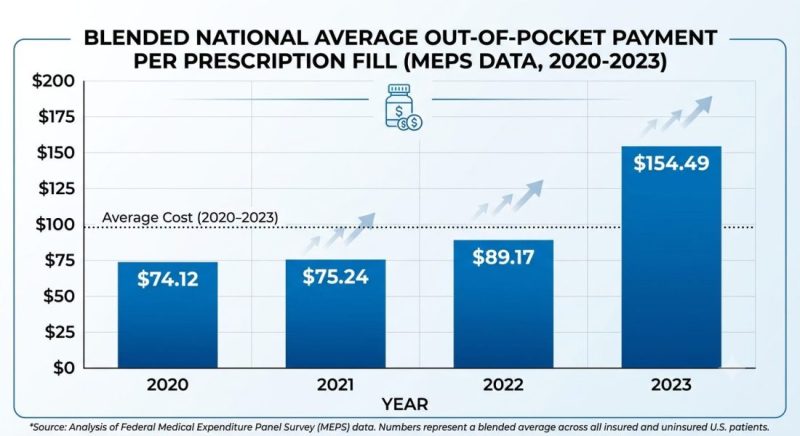
This data highlights the steady increase in average out-of-pocket costs for patients prior to the anticipated market entry of an Eliquis generic. Average annual patient expenses per fill climbed from $74.12 in 2020 to $154.49 by 2023, according to federal Medical Expenditure Panel Survey (MEPS) data.
Why Dosage and Quantity Affect the Final Price
The amount you pay can also change depending on the strength and quantity your doctor prescribes. For a 60-day supply of Eliquis, the cost can be very similar for different strengths. The 2.5 mg dose may cost about $541.39, while the 5 mg dose may cost about $535.95. In many cases, lower-dose tablets can cost nearly the same as higher-dose tablets, depending on the pharmacy and pricing agreements. A 60-day supply usually costs more in total than a 30-day supply, but the cost per tablet may be slightly lower when buying larger quantities.
Why Pharmacy Prices Can Vary
The cost of Eliquis can vary widely between pharmacies, even within the same city or the same chain. Location, pharmacy pricing policies, and wholesale drug costs all play a role in what patients pay out of pocket.
What Else Affects What You Pay
The final cost depends heavily on health insurance coverage. Things like deductibles, plan design, cost-sharing rules, and prior authorization can all affect what patients actually pay out of pocket. Research shows that even insured patients may still face high and unpredictable prescription costs depending on their plan benefits, while people without insurance often pay full cash prices at the pharmacy.
How Insurance Changes the Eliquis Cost Picture
Because insurance has such a large effect on prescription costs, your coverage is often the first place to check. Many Americans with private insurance, Medicare, or Medicaid have coverage for Eliquis. However, coverage details and out-of-pocket costs can vary depending on your specific health plan.
Medicare and Government Savings
For Americans enrolled in Medicare Part D, prescription drug costs may be easier to manage. Beginning in 2025, Medicare Part D includes a $2,000 annual cap on out-of-pocket prescription drug spending. This change may help reduce costs for people who take medications like Eliquis long-term and require ongoing treatment.
Why You May Still Have Out-of-Pocket Costs
Even if an American has health insurance, they may still have out-of-pocket costs for Eliquis because insurance rarely pays 100% of the prescription cost. Instead, the cost is shared between the patient and the insurer. Here are the most common reasons:
| Reason | What It Means |
| Deductible | Many insurance plans require patients to pay the full cost of medications until they meet an annual deductible. |
| Copayment (Copay) | After the deductible is met, the patient may pay a fixed amount (e.g., $30 or $60) for each prescription. |
| Coinsurance | Instead of a fixed copay, some plans require the patient to pay a percentage of the drug’s cost (e.g., 20%–40%). Because Eliquis is expensive, this percentage can still amount to hundreds of dollars. |
| Formulary Tier | Eliquis is often placed on a higher-cost brand-name tier. Drugs on higher tiers usually have larger copays or coinsurance than generic medications. |
| Coverage Gap or Benefit Limits | Depending on the insurance plan, the amount the patient pays can change during the year after reaching certain spending thresholds. |
| Prior Authorization or Step Therapy | Some plans require approval or that a patient try a lower-cost alternative first. If these requirements are not met, the patient may have to pay the full retail price. |
Let’s look at an example. Suppose a 30-day supply of Eliquis has a negotiated price of $600.
- The insurance company pays $480.
- The patient pays $120 (20% coinsurance).
That $120 is the patient’s out-of-pocket cost, even though they have insurance. Another patient with a different insurance plan might pay:
- $45 copay per month.
- $0 after meeting their annual out-of-pocket maximum.
- The full price if they have not yet met their deductible.
How to Save on Eliquis Before the U.S. Generic Arrives
Once you understand why costs vary, the next step is to look at what you can do now. There are several ways to reduce the cost of Eliquis, but not every option is equally reliable or accessible for American families. Understanding your choices can help you find a more sustainable solution for your household budget.
Patient Assistance Programs and Manufacturer Coupons
Patient assistance programs and manufacturer coupons can help reduce out-of-pocket expenses, but they are often temporary fixes rather than long-term savings solutions. These programs may have strict eligibility rules based on income, insurance status, or residency. Coupons may also expire, change, or stop without much notice, which can leave you facing the full retail price later.
Insurance Navigation
Insurance coverage can lower your cost for Eliquis, but plan details vary widely. Even with insurance, you may still face high deductibles, copays, or coverage restrictions. Your plan’s formulary can also change from year to year, which may create unexpected costs. Reviewing your plan can help, but it does not always guarantee affordable access.
Comparing Pharmacy Options
Pharmacy prices for the same medication can vary, so comparing local and online pharmacy options may help you find a better deal. However, even the lowest U.S. pharmacy prices may still be difficult for many patients to afford.
Why Some Americans Compare Canadian Pharmacy Options
If U.S. prices still feel unaffordable after checking coupons, insurance, and local pharmacy prices, Canadian pharmacy options may be worth comparing. For some American patients, ordering through a licensed online Canadian pharmacy service may offer a more consistent long-term savings option than temporary coupons or assistance programs. Because Canada regulates prescription drug pricing differently than the United States, some maintenance medications may be available at lower prices through licensed Canadian pharmacy channels.
For example, through a trusted prescription referral service like Doctorsolve.com, U.S. patients can compare pricing from certified Canadian pharmacy options. DoctorSolve lists Eliquis 2.5 mg, 60 tablets, for $65, compared with typical U.S. prices of more than $541.39 for a similar quantity.
For patients who qualify to order through this type of service, the potential savings may be more predictable than short-term coupons and may not depend on income or insurance status.
You may be able to buy Eliquis for as low as $1.08 per tablet online through a certified pharmacy option listed by Doctorsolve.com.
For many patients, comparing pharmacy options is enough to make Eliquis more affordable. But if the medication is still too expensive, the next conversation should be with your healthcare provider rather than making a medication change on your own.
When to Talk to Your Doctor About Alternatives
If U.S. retail prices for Eliquis are too high for your budget, another option is to ask your doctor whether a different blood thinner may be appropriate. This should be a medical conversation first and a cost conversation second, because blood thinners work differently and are not interchangeable for every patient.
Xarelto (Rivaroxaban)
Xarelto (rivaroxaban) is a once-daily blood thinner that helps prevent strokes and blood clots by blocking a specific clotting protein in your blood. Like Eliquis, it belongs to a newer group of blood thinners called direct oral anticoagulants (DOACs) and usually does not require routine blood clotting tests. In the U.S., a 60-day supply of Xarelto 2.5 mg may cost $743.69, or approximately $4,523.28 per year. If you’re comparing the costs of these two blood thinners, our guide to Eliquis vs Xarelto cost provides a more detailed comparison. Through a trusted online Canadian pharmacy service such as Doctorsolve.com, you may be able to purchase Xarelto 2.5 mg, 60 tablets, for $147, potentially saving more than $3,580 per year compared with typical U.S. retail prices.
Pradaxa (Dabigatran)
Pradaxa (dabigatran) is a direct thrombin inhibitor that helps prevent harmful blood clots by blocking thrombin, one of the body’s main clotting proteins. It is a prescription blood thinner used to help reduce the risk of stroke and other clot-related complications. Pradaxa is one of several modern oral anticoagulants available for people who need blood-thinning medication.
In the U.S., a 60-capsule pack of 75 mg Pradaxa costs $256.29. Because Pradaxa is typically taken twice daily, a 60-capsule pack provides about a 30-day supply. That adds up to approximately $3,118 per year before insurance or discounts. Through a trusted online Canadian pharmacy service such as Doctorsolve.com, you may be able to purchase a 60-capsule pack of Pradaxa 75 mg for $130, potentially saving more than $1,500 per year compared with typical U.S. retail prices.
How Alternatives Compare in Cost and Coverage
Blood thinners are not one-size-fits-all medications. Factors such as kidney function, bleeding risk, age, medical history, and other medications can influence which anticoagulant is most appropriate for a patient. Older anticoagulants such as warfarin generally have lower medication costs but require regular INR (International Normalized Ratio) blood testing and monitoring. Newer anticoagulants, including direct oral anticoagulants (DOACs), typically cost more but generally do not require routine INR monitoring. Any decision to start, stop, or switch a blood thinner should be made with your healthcare provider based on your individual medical needs, not cost alone. If cost is the reason you are considering a change, speak with your doctor first. Your safest option is the medication that fits your diagnosis, health history, bleeding risk, kidney function, and current prescriptions.
References
Agrawal, A., & Goyal, A. (2024). Apixaban. StatPearls Publishing. https://www.ncbi.nlm.nih.gov/books/NBK507910/
Al-Khatib, S. M., Thomas, K. L., & Wallentin, L. (2013). Atrial fibrillation and stroke prevention: Spotlight on apixaban. Journal of Thrombosis and Thrombolysis, 36(2), 125–134. https://pmc.ncbi.nlm.nih.gov/articles/PMC3684191/
Bansal, S., & Shinde, V. (2018). Clinical utility of apixaban in the prevention of stroke and systemic embolism in patients with non-valvular atrial fibrillation. Journal of Clinical Medicine Research, 10(6), 451–458. https://pmc.ncbi.nlm.nih.gov/articles/PMC5933600/
Byon, W., Garonzik, S., Boyd, R. A., & Frost, C. E. (2019). Apixaban clinical pharmacokinetics and pharmacodynamics. Clinical Pharmacokinetics, 58(10), 1265–1279. https://pmc.ncbi.nlm.nih.gov/articles/PMC6355356/
Doherty, J. U., Gluckman, T. J., & Hucker, W. J. (2017). 2017 ACC expert consensus decision pathway on management of bleeding in patients on oral anticoagulants. Journal of the American College of Cardiology, 70(24), 3042–3067. https://pmc.ncbi.nlm.nih.gov/articles/PMC6074234/
Granger, C. B., Alexander, J. H., & McMurray, J. J. (2012). Apixaban versus warfarin in patients with atrial fibrillation. New England Journal of Medicine, 365(11), 981–992. https://pmc.ncbi.nlm.nih.gov/articles/PMC3307559/
Hindricks, G., Potpara, T., & Dagres, N. (2021). 2020 ESC Guidelines for the diagnosis and management of atrial fibrillation developed in collaboration with EACTS. European Heart Journal, 42(5), 373–498. https://pmc.ncbi.nlm.nih.gov/articles/PMC7966436/
Lopez-Lopez, J. A., Sterne, J. A., & Thom, H. H. (2017). Oral anticoagulants for prevention of stroke in atrial fibrillation: Systematic review and network meta-analysis. BMJ, 359, j5058. https://pmc.ncbi.nlm.nih.gov/articles/PMC11091822/
Neumann, I., Schünemann, H. J., Bero, L., Cooke, G., Magrini, N., & Moja, L. (2021). Global access to affordable direct oral anticoagulants. Bulletin of the World Health Organization, 99(9), 653–660. https://pmc.ncbi.nlm.nih.gov/articles/PMC8381095/
Ruff, C. T., Giugliano, R. P., & Braunwald, E. (2014). Comparison of the efficacy and safety of new oral anticoagulants with warfarin in patients with atrial fibrillation: A meta-analysis of randomised trials. The Lancet, 383(9921), 955–962. https://pmc.ncbi.nlm.nih.gov/articles/PMC3968084/
Seeger, J., & Wöhrle, J. (2020). Apixaban: An update of the evidence for its place in the prevention of stroke in patients with atrial fibrillation. Core Evidence, 15, 1–6. https://pmc.ncbi.nlm.nih.gov/articles/PMC6982431/
Sharma, M., Ramanathan, S., & Khalighi, K. (2017). Development of new deep venous thrombosis while on apixaban. Case Reports in Cardiology, 2017, 1–3. https://pmc.ncbi.nlm.nih.gov/articles/PMC5496103/
Sharma, L., Prakash, A., & Medhi, B. (2024). Ensuring medication and patient safety for better quality healthcare. Indian Journal of Pharmacology, 56(5), 375–378. https://pmc.ncbi.nlm.nih.gov/articles/PMC11913332/
Steffel, J., Collins, R., & Antz, M. (2021). 2021 European Heart Rhythm Association practical guide on the use of non-vitamin K antagonist oral anticoagulants in patients with atrial fibrillation. Europace, 23(10), 1612–1676. https://pmc.ncbi.nlm.nih.gov/articles/PMC9013034/
Widimsky, P., & Twyman, V. (2025). Safety profiles and clinical efficacy of novel oral anticoagulants in real-world environments. Journal of Cardiovascular Medicine, 26(2), 89–97. https://pmc.ncbi.nlm.nih.gov/articles/PMC11650386/
National Center for Biotechnology Information. (2023). Deep vein thrombosis (DVT) prophylaxis. NCBI Bookshelf. https://www.ncbi.nlm.nih.gov/books/NBK519025/
National Center for Biotechnology Information. (2024). Direct oral anticoagulants (DOACs) pharmacology and monitoring. PMC Digital Library. https://pmc.ncbi.nlm.nih.gov/articles/PMC11428250/
National Center for Biotechnology Information. (2025). Efficacy and real-world evaluation of non-vitamin K antagonist oral anticoagulants. PMC Digital Library. https://pmc.ncbi.nlm.nih.gov/articles/PMC12296649/
National Center for Biotechnology Information. (2024). Bioequivalence criteria and standards for generic applications. PMC Digital Library. https://pmc.ncbi.nlm.nih.gov/articles/PMC10501782/
National Center for Biotechnology Information. (2025). Regulatory and structural timelines of primary patent expirations. PMC Digital Library. https://pmc.ncbi.nlm.nih.gov/articles/PMC12641685/
National Center for Biotechnology Information. (2024). Economic evaluations of stroke prevention protocols in atrial fibrillation. PMC Digital Library. https://pmc.ncbi.nlm.nih.gov/articles/PMC10922581/
National Center for Biotechnology Information. (2024). Evaluating adherence and persistence trends in long-term anticoagulant therapies. PMC Digital Library. https://pmc.ncbi.nlm.nih.gov/articles/PMC11982810/
National Center for Biotechnology Information. (2024). Management strategies for minor and major bleeding risks during direct factor Xa inhibitor therapy. PMC Digital Library. https://pmc.ncbi.nlm.nih.gov/articles/PMC11953867/
National Center for Biotechnology Information. (2025). Comparative analysis of safety dynamics across generation-two direct oral anticoagulants. PMC Digital Library. https://pmc.ncbi.nlm.nih.gov/articles/PMC12634970/
National Center for Biotechnology Information. (2023). Evolving regulatory landscape for abbreviated new drug application review pathways. PMC Digital Library. https://pmc.ncbi.nlm.nih.gov/articles/PMC9767653/
National Center for Biotechnology Information. (2024). Pharmacoeconomic assessment of antithrombotic therapies within modern public health structures. PMC Digital Library. https://pmc.ncbi.nlm.nih.gov/articles/PMC11634925/
U.S. Food and Drug Administration. (2012). Eliquis (apixaban) tablets, for oral use [Prescribing Information]. https://www.accessdata.fda.gov/drugsatfda_docs/label/2012/202155s000lbl.pdf
U.S. Food and Drug Administration. (2020). ANDA Tentative Approval Letter – Apixaban tablets. https://www.accessdata.fda.gov/drugsatfda_docs/appletter/2020/210142Orig1s000TA_ltr.pdf
U.S. Food and Drug Administration. (2022). Abbreviated New Drug Application (ANDA). https://www.fda.gov/drugs/types-applications/abbreviated-new-drug-application-anda
U.S. Food and Drug Administration. (2023). What is the approval process for generic drugs?https://www.fda.gov/drugs/generic-drugs/what-approval-process-generic-drugs
U.S. Food and Drug Administration. (2021). Exclusivity and generic drugs: What does it mean?https://www.fda.gov/files/drugs/published/Exclusivity-and-Generic-Drugs–What-Does-It-Mean-.pdf
U.S. Food and Drug Administration. (2024). Generic drugs: Questions & answers. https://www.fda.gov/drugs/generic-drugs/generic-drugs-questions-answers
Centers for Disease Control and Prevention. (2024). Atrial fibrillation. U.S. Department of Health and Human Services. https://www.cdc.gov/heart-disease/about/atrial-fibrillation.html
MedlinePlus. (2023). Apixaban. American Society of Health-System Pharmacists, Inc. / National Library of Medicine. https://medlineplus.gov/druginfo/meds/a613032.html?utm_source=chatgpt.com
National Heart, Lung, and Blood Institute. (2024). Atrial fibrillation estimated to affect about 1 in 22 Americans. National Institutes of Health. https://www.nhlbi.nih.gov/news/2024/atrial-fibrillation-estimated-affect-about-1-22-americans
Eunice Kennedy Shriver National Institute of Child Health and Human Development. (2022). How are drugs approved for use? National Institutes of Health. https://www.nichd.nih.gov/health/topics/pharma/conditioninfo/approval
Drugs.com. (2024). Generic Eliquis availability. https://www.drugs.com/availability/generic-eliquis.html
Drugs.com. (2024). Eliquis: Uses, dosage, side effects & warnings. https://www.drugs.com/eliquis.html
Drugs.com. (2023). How do you stop and start Eliquis for surgery? https://www.drugs.com/medical-answers/how-stop-start-eliquis-surgery-3578343/
WebMD. (2024). Eliquis for blood clots and stroke prevention. https://www.webmd.com/heart-disease/atrial-fibrillation/eliquis-blood-clot-stroke

 Previous Post