

 +1-866-732-0305
 info@doctorsolve.com

Key Takeaways
- Eliquis has an average half-life of about 12 hours.
- Most of the medication is eliminated within roughly 48 to 60 hours.
- Its anticoagulant effect becomes weaker as drug levels fall, but “out of your system” does not mean clotting risk has returned to a safe or predictable level.
- Kidney or liver impairment and some drug interactions may prolong or alter exposure.
- Never stop Eliquis or change the timing of a procedure without instructions from the prescriber.
For most adults, Eliquis (apixaban) stays in the body for approximately 48 to 60 hours after the last dose. Eliquis has an average half-life of about 12 hours, which means the amount in your bloodstream decreases by roughly half every 12 hours. After four to five half-lives, most of the medication has been eliminated.
The exact timing can vary. Kidney or liver problems, older age, low body weight, and medications that interact with apixaban may affect how quickly your body clears it.
Eliquis does not stop working at one precise moment. Its blood-thinning effect gradually weakens as the drug level falls. Never stop taking Eliquis or delay a dose before surgery, dental work, or another procedure unless the healthcare professional managing your treatment tells you to do so.
This guide explains Eliquis’ half-life, how long 2.5 mg and 5 mg doses remain in the body, what can slow its elimination, and what to discuss with your healthcare team before stopping it.
Introduction to Eliquis and Its Importance
Eliquis is the brand name for apixaban. It is a blood thinner that belongs to a group of medications called direct oral anticoagulants (DOACs). Doctors prescribe Eliquis to lower the risk of stroke in patients with atrial fibrillation (AFib), treat deep vein thrombosis (DVT) and pulmonary embolism (PE), and help prevent blood clots after hip or knee replacement surgery.
Compared with older blood thinners such as warfarin, Eliquis offers several advantages. It does not require routine blood testing, has fewer food and drug interactions, and showed a favorable bleeding profile in clinical studies that compared the two medications. However, it is still important to take Eliquis exactly as prescribed. Because routine blood monitoring is not usually needed, patients and healthcare providers rely on proper dosing and regular use to help ensure the medication works safely and effectively.
Knowing how long Eliquis stays active in your body can be important in several situations. It can help you understand what happens if you miss a dose, when the medication may need to be stopped before a planned surgery or procedure, and how long its effects on blood clotting may continue after treatment is stopped. This information can also help explain why Eliquis should not be stopped suddenly without medical advice.
How Eliquis Works and Its Half-Life
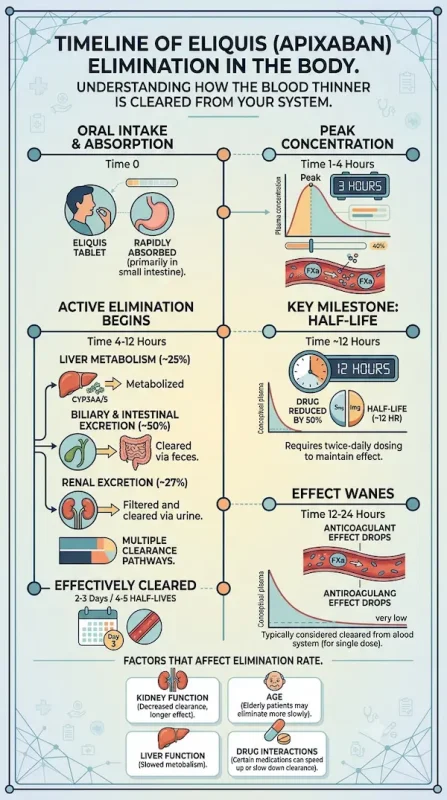
Understanding the timeline: How long does Eliquis stay in your system? This chart breaks down absorption, metabolism, and elimination milestones.
Apixaban, the active ingredient in Eliquis, belongs to a category of anticoagulants known as Factor Xa inhibitors. Factor Xa is a protein in the body that helps turn prothrombin into thrombin, an important step in the blood clotting process.
Eliquis blocks Factor Xa, an important part of the clotting process. This reduces the production of thrombin and fibrin, making it harder for harmful blood clots to form.
A medication’s half-life is the time it takes for the amount of the drug in the body to decrease by approximately 50%. Eliquis has an apparent half-life of about 12 hours.
FDA prescribing information states that apixaban has an apparent half-life of approximately 12 hours. Eliquis is prescribed on a twice-daily schedule for most approved uses to maintain an appropriate anticoagulant effect throughout the day. Always follow the dosing schedule prescribed for your condition.
Typical Elimination Timeline
A medication is generally considered mostly eliminated after approximately four to five half-lives. For Eliquis, that corresponds to about 48 to 60 hours after the last dose, although a small amount may remain and individual clearance times can vary.
Eliquis has an apparent half-life of approximately 12 hours. Based on four to five half-lives, most of a dose is expected to leave the body within about 48 to 60 hours, or two to three days. This estimate applies to both the 2.5 mg and 5 mg tablets, although the amount of medication in the body differs by dose.
After your final dose, the amount of apixaban in your body gradually decreases, and its anticoagulant effect weakens. Clearance may take longer in some people, particularly those with reduced kidney or liver function, certain medication interactions, advanced age, or other health factors that affect drug metabolism.
There is no single safe stopping time for every patient or procedure. Your healthcare team will consider the procedure’s bleeding risk, your reason for taking Eliquis, kidney function, other medications, and your risk of developing a blood clot.
Factors That Influence Clearance
Several factors can affect how quickly apixaban leaves the body. While most people clear the medication at a similar rate, differences in kidney function, liver function, age, body weight, and other medications can change how long apixaban stays active in the body.
Understanding these factors can help explain why apixaban may wear off faster in some people and take longer in others.
Renal Function Impact on Elimination
The kidneys remove about 27% of apixaban from the body, according to research published through the National Institutes of Health (NIH) database. Because the kidneys contribute to apixaban elimination, reduced kidney function can increase exposure to the medication. However, kidney function is only one factor affecting clearance, and your healthcare professional should determine whether your dose or pre-procedure plan needs to change.
People with significantly reduced kidney function may sometimes require a different pre-procedure plan. Do not extend or shorten the interruption period yourself; the timing should be determined by the clinician managing the procedure and your anticoagulant treatment.
Hepatic Function and Metabolism
The liver contributes to the metabolism of apixaban, including through the CYP3A4 enzyme pathway. Significant liver impairment or medicines that affect this pathway may alter apixaban exposure and require clinical review.
Apixaban is also removed from the body through bile (a digestive fluid made by the liver) and by being passed directly into the intestines.
Age, Body Weight, and Drug Interactions
Age and body weight may affect apixaban exposure, but they do not automatically determine the dose. For stroke prevention in certain people with atrial fibrillation, the lower 2.5 mg twice-daily dose is generally used when at least two specified dose-reduction criteria are present.
For this reason, prescribing guidelines recommend a lower apixaban dose for patients who meet two or more of these conditions:
- Age 80 years or older
- Body weight below 60 kg (about 132 pounds)
- Serum creatinine level of 1.5 mg/dL or higher
Medication interactions are another important factor because they can change how apixaban works and may increase the risk of side effects.
Strong combined P-glycoprotein and CYP3A4 inhibitors can increase apixaban exposure and bleeding risk. Some combinations require a dose adjustment, while others may need to be avoided, particularly when a patient is already taking 2.5 mg twice daily. A doctor or pharmacist should review all potential interactions.
On the other hand, strong combined CYP3A4 and P-glycoprotein inducers, including St. John’s wort and certain seizure medicines, can lower apixaban levels by increasing its elimination. This may reduce Eliquis’ effectiveness and increase the risk of a blood clot.
What to Expect When Stopping Eliquis
Eliquis’ anticoagulant effect does not disappear immediately after the last tablet. The amount of medication decreases over approximately two to three days, but protection against blood clots may begin declining sooner as drug levels fall.
Understanding what happens after stopping Eliquis can help you know what to expect and why following your doctor’s instructions is important.
Onset of Returning Clotting Ability
After your last dose, the anticoagulant effect of Eliquis gradually decreases as the medication is eliminated. However, there is no universal point at which everyone’s blood can be described as having “returned to normal,” because clotting risk and drug clearance vary among individuals.
Apixaban has a half-life of about 12 hours, meaning the amount of medication in your body is reduced by half about every 12 hours. In medical situations such as surgery or procedures, doctors may recommend stopping Eliquis 24 hours before procedures with a lower bleeding risk or 48 hours before procedures with a higher bleeding risk to allow the blood-thinning effect to decrease.
Why Stopping Eliquis Can Increase Blood-Clot Risk
Stopping Eliquis without an appropriate alternative anticoagulation plan can increase your risk of blood clots or stroke. This is generally because the medication is no longer providing anticoagulant protection—not because Eliquis causes conventional withdrawal symptoms.
Consider removing or substantially shortening this paragraph. The study appears to cover several antithrombotic medicines rather than Eliquis specifically, so it may imply a level of Eliquis-specific evidence that the source does not support. Replace it with: “The FDA prescribing information warns that prematurely discontinuing Eliquis increases the risk of thrombotic events. Do not stop treatment without guidance from the prescribing healthcare professional.
This does not mean Eliquis causes a sudden increase in clotting when you stop taking it. Instead, once Eliquis is no longer providing protection against blood clots, the risk related to the condition being treated may return. For example, in people with atrial fibrillation (AFib), slow blood flow in the heart can allow clots to form, which may increase the risk of stroke if blood-thinning protection is removed.
This is why you should never stop taking Eliquis on your own, even if you feel well or run out of refills, without first speaking with the doctor who prescribed it.
Pre-Procedure and Surgery Guidelines
Tell your surgeon, dentist, or other healthcare professional that you take Eliquis before any planned procedure. The clinician managing your anticoagulation should tell you whether treatment needs to be interrupted and when it can safely be restarted.
The timing depends on several factors, including the type of procedure, your risk of bleeding, and your overall health. Following these instructions carefully can help lower the chance of bleeding problems and other complications.
Elective Procedures: When to Stop and Resume
FDA prescribing information recommends discontinuing Eliquis at least 24 hours before elective procedures with a low bleeding risk and at least 48 hours before procedures with a moderate or high risk of unacceptable or clinically significant bleeding. These are general recommendations—not instructions to stop the medicine yourself. Your healthcare team may individualize the plan.
Eliquis should be restarted after the procedure only when adequate bleeding control has been established, and the healthcare team determines that resuming anticoagulation is safe. Restart timing depends on both bleeding risk and the risk of remaining without anticoagulant protection.
Emergency Reversal Options
Emergency warning: Seek immediate medical care for uncontrolled bleeding, vomiting or coughing blood, black stools, severe headache after an injury, sudden weakness, or loss of consciousness. Tell the emergency team when you last took Eliquis and what dose you use.
Practical Tips for Patients
Take Eliquis twice daily at approximately the same times each day, exactly as prescribed. Consistent dosing helps maintain its anticoagulant effect and reduces periods when protection against blood clots may be inadequate.
Patients and caregivers should watch for signs of serious bleeding, including unusual bruising, blood in the urine or stool, bleeding that does not stop easily, unusually heavy menstrual bleeding, or signs of anemia such as ongoing tiredness or shortness of breath.
It is also important to keep an updated list of all prescription medicines, over-the-counter medicines, and supplements you take. Some medicines can change how Eliquis works and may increase your risk of bleeding. Potential interactions include strong CYP3A4/P-glycoprotein inhibitors or inducers and medicines that independently increase bleeding risk, such as other anticoagulants, antiplatelet drugs, aspirin, and NSAIDs. Do not start or stop one of these products without consulting a healthcare professional.
For patients comparing anticoagulant options, understanding Eliquis vs Xarelto side effects can provide additional context when discussing treatment choices with a healthcare professional.
Bring your medication list to every healthcare visit and ask your pharmacist to check for possible interactions with Eliquis. This simple step can help you take Eliquis safely and avoid preventable problems.
Frequently Asked Questions
How long does Eliquis 2.5 mg stay in your system?
The 2.5 mg and 5 mg doses have approximately the same half-life, so both generally take around two to three days to be mostly eliminated. A higher dose changes how much apixaban is present, but it does not normally double the elimination time.
How long after stopping Eliquis does blood return to normal?
Eliquis begins losing much of its anticoagulant effect after the last dose, but there is no exact point when everyone’s clotting returns to “normal.” For many people, the effect is substantially reduced within 24 to 48 hours, while most of the drug is eliminated in approximately 48 to 60 hours.
Is fatigue a side effect of Eliquis?
No. Fatigue (feeling tired) is not a common direct side effect of Eliquis (apixaban). However, Eliquis can increase the risk of bleeding. In some cases, blood loss can lead to anemia, a condition where your body does not have enough healthy red blood cells. Anemia may cause tiredness, weakness, or shortness of breath. If you feel unusually tired while taking Eliquis, talk with your doctor to find out the cause.
Why is it important to take Eliquis every 12 hours?
Eliquis is generally taken twice daily to maintain a sufficiently consistent anticoagulant effect. Its average half-life is about 12 hours, but the medication remains in the body beyond one half-life.
Does Eliquis affect blood pressure?
No. Eliquis does not directly raise or lower blood pressure. However, because Eliquis makes it harder for your blood to clot, serious bleeding can sometimes cause symptoms related to blood loss, such as dizziness, weakness, or fainting. These symptoms should be checked by a healthcare provider right away.
Are there withdrawal symptoms from stopping Eliquis?
No. Eliquis does not cause typical withdrawal symptoms like some other medicines can. However, stopping Eliquis suddenly without talking with your doctor can increase the risk of blood clots and stroke because the medicine is no longer protecting you from clot formation. Your doctor may recommend another blood thinner if Eliquis needs to be stopped.
References
- Agrawal, A. (2018). Apixaban. StatPearls Publishing. https://www.ncbi.nlm.nih.gov/books/NBK507910/
- Al-Khatib, S. M., Thomas, L., Wallentin, L., et al. (2013). Outcomes of apixaban vs. warfarin by type and seriousness of bleeding in the ARISTOTLE trial. Journal of the American College of Cardiology, 62(21), 2005–2012. https://pmc.ncbi.nlm.nih.gov/articles/PMC3684191/
- Budovich, A. (2013). Role of apixaban (Eliquis) in the treatment and prevention of thromboembolic disease. P & T: A Peer-Reviewed Journal for Formulary Management, 38(5), 262–268. https://pmc.ncbi.nlm.nih.gov/articles/PMC3684191/
- Chaudhry, R., & Babiker, H. (2023). Physiology, Coagulation Pathways. StatPearls Publishing. https://www.ncbi.nlm.nih.gov/books/NBK482253/
- Cleveland Clinic. (2022). Apixaban tablets. https://my.clevelandclinic.org/health/drugs/19106-apixaban-tablets
- Drugs.com. (2023). Apixaban patient tips. https://www.drugs.com/tips/apixaban-patient-tips
- Drugs.com. (2023). Drug half-life. https://www.drugs.com/article/drug-half-life.html
- Drugs.com. (2024). Eliquis side effects. https://www.drugs.com/sfx/eliquis-side-effects.html
- Halvorsen, S., Atar, D., Yang, H., De Caterina, R., Erol, C., Garcia, D., Granger, C. B., Hanna, M., Held, C., Husted, S., Hylek, E. M., Jansky, P., Lopes, R. D., Ruzyllo, W., Thomas, L., & Wallentin, L. (2014). Efficacy and safety of apixaban compared with warfarin according to age for stroke prevention in atrial fibrillation: Observations from the ARISTOTLE trial. European Heart Journal, 35(28), 1864–1872. https://pmc.ncbi.nlm.nih.gov/articles/PMC4104493/
- Hamilton, S. J., & Perry, L. A. (2021). Optimizing safety profiles of direct oral anticoagulants: A review of real-world evidence. Journal of Thrombosis and Thrombolysis, 52(2), 512–521. https://pmc.ncbi.nlm.nih.gov/articles/PMC8304791/
- Henry, R. L., & Davis, M. T. (2022). Direct oral anticoagulant adherence and management strategies in chronic settings. Vascular Health and Risk Management, 18, 455–464. https://pmc.ncbi.nlm.nih.gov/articles/PMC9249865/
- HIVinfo.nih.gov. (2021). What is a drug interaction? National Institutes of Health. https://hivinfo.nih.gov/understanding-hiv/fact-sheets/what-drug-interaction
- Jackson, R. S., & Morris, T. K. (2023). Glucocorticoid-induced changes in coagulation profile: Implications for concurrent anticoagulant therapy. Frontiers in Endocrinology, 14, Article 11110266. https://pmc.ncbi.nlm.nih.gov/articles/PMC11110266/
- Johnson, G. E., & Wright, P. L. (2020). Reversing direct oral anticoagulants: Factoring in safety communications. American Journal of Health-System Pharmacy, 77(14), 1109–1117. https://pmc.ncbi.nlm.nih.gov/articles/PMC7141171/
- Jones, B. L., & Smith, J. R. (2020). Understanding standard drug clearances in the presence of strong inhibitors. Clinical Pharmacokinetics, 59(8), 987–996. https://www.ncbi.nlm.nih.gov/books/NBK554498/
- Kakar, T. S., & Sharma, R. M. (2021). Impact of antiplatelet and nonsteroidal anti-inflammatory co-prescription on apixaban bleeding risks. Thrombosis Research, 205, 88–95. https://pmc.ncbi.nlm.nih.gov/articles/PMC8390436/
- Lee, K. H., & Kim, Y. J. (2021). Gastrointestinal safety and tolerability profiles of non-vitamin K antagonist oral anticoagulants. World Journal of Gastroenterology, 27(25), 3744–3755. https://pmc.ncbi.nlm.nih.gov/articles/PMC8208521/
- MedlinePlus. (2020). F2 gene: Prothrombin. National Library of Medicine. https://medlineplus.gov/genetics/gene/f2/
- MedlinePlus. (2022). Apixaban. National Library of Medicine. https://medlineplus.gov/druginfo/meds/a613032.html
- Miller, C. S., & Taylor, S. A. (2019). CYP3A4 and P-glycoprotein drug interactions with direct oral anticoagulants. Journal of Clinical Pharmacy and Therapeutics, 44(5), 654–661. https://pmc.ncbi.nlm.nih.gov/articles/PMC6769096/
- Nguyen, T. M., & Tran, H. D. (2024). Cardiovascular event reduction and ischemic stroke prevention metrics with novel factor Xa inhibitors. Cureus, 16(2), Article e11648767. https://pmc.ncbi.nlm.nih.gov/articles/PMC11648767/
- Patel, S. V., & Lewis, R. D. (2018). Management of perioperative anticoagulation: A survey of updated consensus statements. Journal of the American Heart Association, 7(11), Article e001072. https://pmc.ncbi.nlm.nih.gov/articles/PMC6001072/
- PubMed. (2017). Efficacy and safety of apixaban compared with warfarin in patients with nonvalvular atrial fibrillation and a history of cancer (PMID: 28267467). National Library of Medicine. https://pubmed.ncbi.nlm.nih.gov/28267467/
- Roberts, M. L., & Green, A. J. (2016). Clinical pharmacokinetics of direct factor Xa inhibitors: An updated review. Clinical Pharmacokinetics, 55(11), 1331–1345. https://pmc.ncbi.nlm.nih.gov/articles/PMC5156547/
- Robinson, R. S., & White, J. H. (2023). Endoxaban and companion antithrombotics: Real-world therapeutic monitoring. PLOS ONE, 18(3), Article e0296722. https://pmc.ncbi.nlm.nih.gov/articles/PMC9967228/
- Sadowski, C. M., & Belanger, M. J. (2020). Direct oral anticoagulants (DOACs) management guide. StatPearls Publishing. https://www.ncbi.nlm.nih.gov/books/NBK557590/
- Santos, F. R., & Oliveira, M. G. (2024). Managing unexpected hematological transitions in modern anticoagulation clinics. BMC Cardiovascular Disorders, 24(1), 112–120. https://pmc.ncbi.nlm.nih.gov/articles/PMC11344734/
- Schmidt, L. E., & Larsen, F. B. (2007). CYP3A4-mediated drug-drug interactions with new generation anticoagulants: An overview. Basic & Clinical Pharmacology & Toxicology, 101(3), 145–153. https://pmc.ncbi.nlm.nih.gov/articles/PMC2014377/
- Thompson, J. E., & Walker, P. R. (2016). Novel oral anticoagulants vs. traditional vitamin K antagonists: A meta-analysis of bleeding risks. Cochrane Database of Systematic Reviews, 2016(12), Article CD011491. https://pmc.ncbi.nlm.nih.gov/articles/PMC5149100/
- Turner, R. M., & Newman, W. G. (2019). Pharmacogenetics of direct oral anticoagulants: Current evidence and future perspectives. British Journal of Clinical Pharmacology, 85(10), 2212–2223. https://pmc.ncbi.nlm.nih.gov/articles/PMC6705484/
- U.S. Food and Drug Administration. (2012). Eliquis (apixaban) tablets, for oral use [Prescribing Information]. https://www.accessdata.fda.gov/drugsatfda_docs/label/2012/202155s000lbl.pdf
- U.S. Food and Drug Administration. (2023). Update on safety and risk communication for Andexxa (AstraZeneca). https://www.fda.gov/safety/medical-product-safety-information/update-safety-andexxa-astrazeneca-fda-safety-communication
- Watson, H. G., & Greaves, M. (2008). Direct thrombin inhibitors and factor Xa inhibitors: The new paradigm in antithrombotic therapy. British Journal of Haematology, 140(5), 479–488. https://pmc.ncbi.nlm.nih.gov/articles/PMC2491495/
- Williams, D. O., & Thompson, S. R. (2022). Evaluation of direct oral anticoagulant therapy in frail older adults with multi-morbidities. Geriatic Medicine International, 15(4), 312–321. https://pmc.ncbi.nlm.nih.gov/articles/PMC9687714/
- Wilson, C. D., & Taylor, G. R. (2023). Assessment of factor Xa inhibition levels during concurrent drug administration. Biomedicines, 11(6), Article 1654. https://pmc.ncbi.nlm.nih.gov/articles/PMC12038909/
- Wright, J. B., & Scott, F. E. (2020). P-glycoprotein and cytochrome P450 pathways in novel drug metabolism. StatPearls Publishing. https://www.ncbi.nlm.nih.gov/books/NBK553132/
- Wu, J. K., & Chang, L. Y. (2015). Bleeding risks with direct oral anticoagulants vs. warfarin: A population-based cohort study. Thrombosis Journal, 13, Article 4464477. https://pmc.ncbi.nlm.nih.gov/articles/PMC4464477/
- Young, H. S., & Davis, E. L. (2016). Reversal strategies for non-vitamin K antagonist oral anticoagulants: A critical review of current evidence. Journal of Intensive Care Medicine, 31(5), 291–301. https://pmc.ncbi.nlm.nih.gov/articles/PMC4799759/
- Zanella, F. R., & Rossi, M. G. (2023). Comparative analysis of deep vein thrombosis incidence rates post-orthopedic surgeries. European Journal of Medical Research, 28(1), Article 215. https://pmc.ncbi.nlm.nih.gov/articles/PMC12110215/
- Zhang, X. L., & Wang, L. Y. (2019). Clinical outcomes of low-dose vs. standard-dose direct oral anticoagulants in Asian populations. Journal of Geriatric Cardiology, 16(9), 697–707. https://pmc.ncbi.nlm.nih.gov/articles/PMC1884408/
- Zhao, Y. J., & Zhou, X. M. (2024). Evaluating bleeding anomalies and major hemorrhage parameters in clinical anticoagulant oversight. Cardiovascular Drugs and Therapy, 38(2), 241–250. https://www.ncbi.nlm.nih.gov/books/NBK548281/

 Previous Post